Attribute, Observe, Enforce, Optimize
Most organizations don’t decide to lose control of their AI spend. They just skip a step. They stand up an impressive AI capability, wire it to the frontier models, ship real value - and never build the boring layer underneath that says who’s spending what and whether that’s okay.
The good news is that getting control isn’t a single heroic project. It’s a ladder with four rungs, and each one delivers value on its own. You don’t have to reach the top to benefit; you just have to know which rung you’re on and take the next step deliberately.
The four rungs are Attribute, Observe, Enforce, Optimize. Here’s what each one means, what it looks like when you’ve got it, and how you know you’re ready to climb.
Rung 1 - Attribute: give every dollar an owner
Everything starts here, and most organizations are stuck below it without realizing.
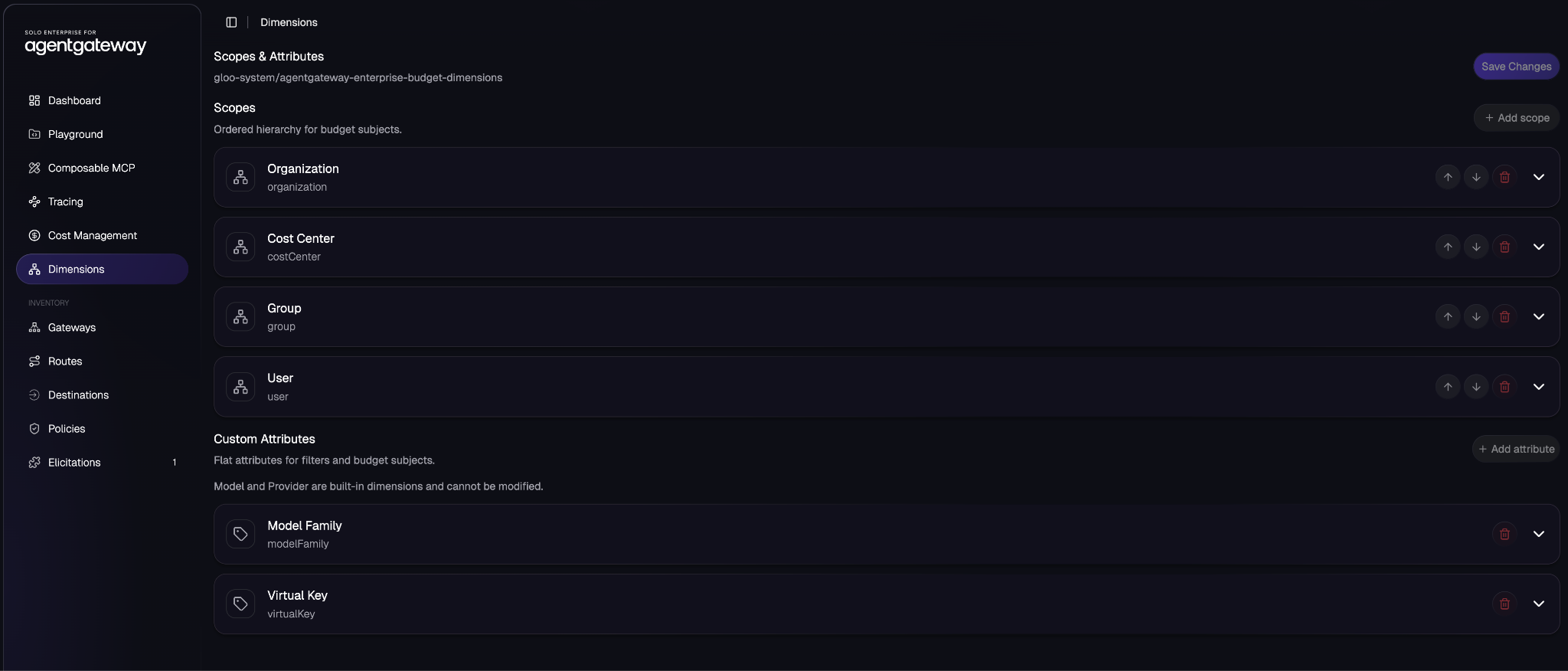
Attribution means every LLM request carries the business context you care about at the moment it’s made - not reconstructed later from an invoice. The platform calls these dimensions, and they come in two flavors that map cleanly onto how a business is actually structured.
The first flavor is a hierarchy of scopes - an ordered chain from broad to narrow. Organization at the top, then cost center, then group, then user. The order matters: it’s the parent-child structure of accountability in your company, from the whole org down to a single person. This is the spine of chargeback, because it lets spend roll up and drill down along the same lines your finance team already thinks in.
The second flavor is attributes - labels that don’t nest inside each other but describe a request from the side: the model family, the virtual key, and so on. A request doesn’t belong to a model family the way a user belongs to a cost center; it just has one. These are the orthogonal facts about a request that make filtering powerful.
Two of these dimensions - the model and the provider - the gateway knows on its own, for free, on every request. It can see which model answered and which vendor served it without you configuring anything. The rest - your cost centers, your team names, your org structure - you define once so the system speaks your language instead of a generic one.
You’re on this rung when: every request can be traced back to a team and a cost center without a spreadsheet. You’re ready to climb when: that’s true and you want to actually look at the numbers.
Rung 2 - Observe: make the spend impossible to ignore
Attribution is potential energy. Observation is where it becomes useful.
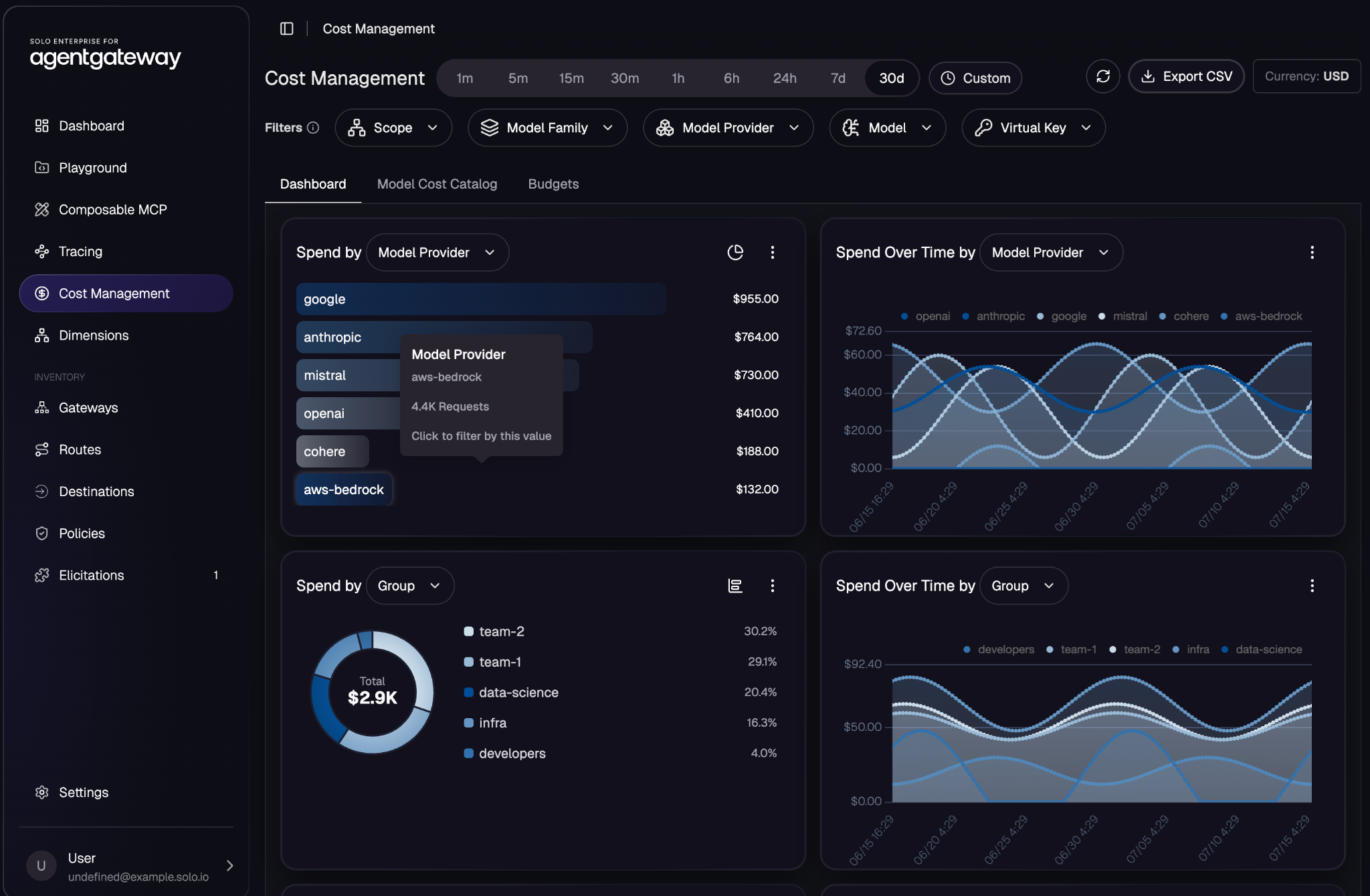
Once requests are tagged, the spend they generate flows into a live view you can slice by any dimension you defined. Spend by provider. Spend by team. Spend over time. Filter to one group, one model, one virtual key, and watch the picture narrow to exactly the question you’re asking.
Two capabilities on this rung deserve special attention because they’re the ones people underestimate.
The first is spend over time. A single total is a snapshot; a trend is a story. The trend tells you whether spend is accelerating, whether last week’s optimization worked, and whether that scary spike was a one-off or the new normal. Governance lives in the derivative, not the number.
The second is the Model Cost Catalog - and this one is the quiet backbone of the entire system. Every dollar figure you see anywhere in the platform is only as trustworthy as the prices behind it. The catalog is that source of truth: a per-model price list showing input and output costs per million tokens, plus the finer-grained cache-read and cache-write rates, each with an effective date so historical spend is priced with the rates that were actually in force at the time. It even supports pattern matching, so a whole family of related model versions can share a pricing rules.
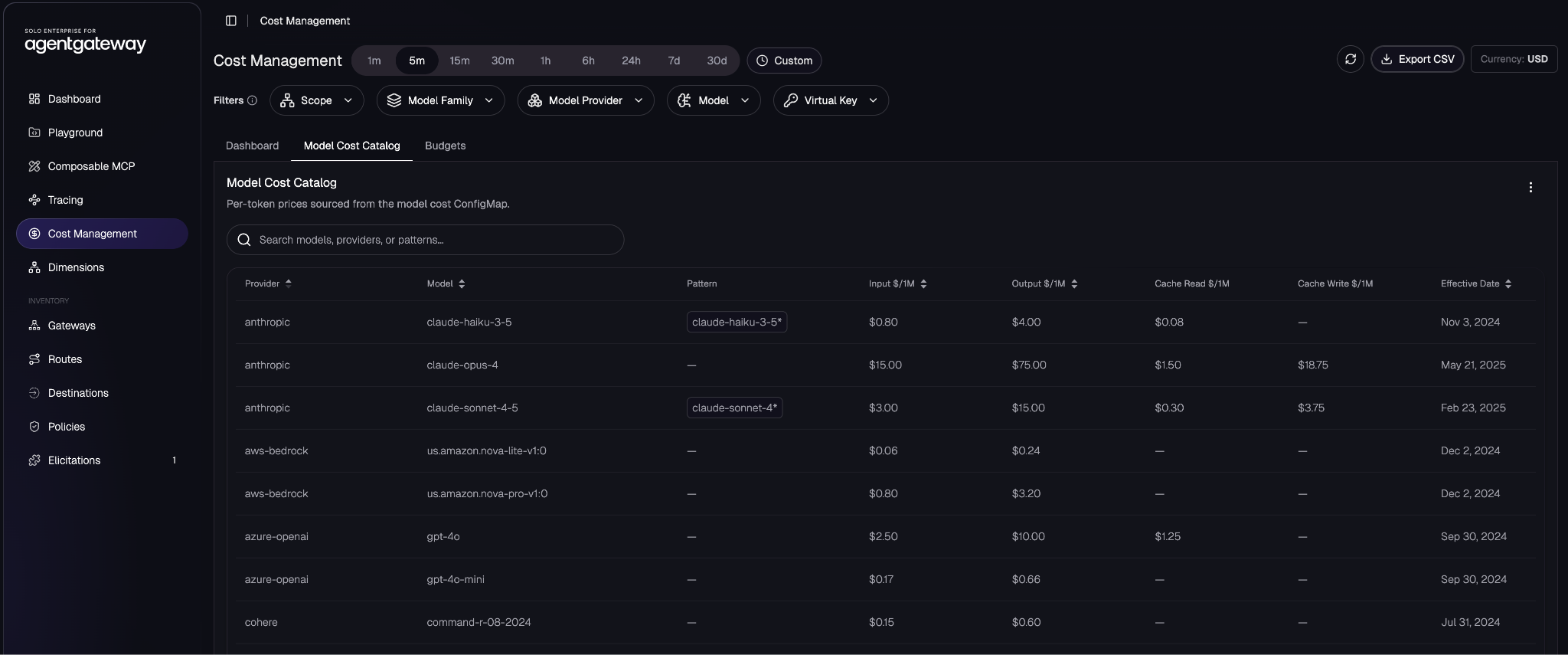
That’s why “how much did we spend” has a defensible answer here and not just an estimate. The number traces back to a published, versioned price for the exact model that served each request.
You’re on this rung when: you can answer a spending question in a meeting instead of scheduling a week of analysis. You’re ready to climb when: seeing the spend is no longer enough and you need to bound it.
Rung 3 - Enforce: turn insight into limits
Watching a number climb is not control. Control is when the system does something when the number gets too high - automatically, without waiting for a human to notice.
This is what budgets provide. A budget sets a limit on a slice of spend and says what happens when that slice crosses the line. Three design choices make budgets genuinely useful rather than blunt:
They’re limited by what matters - money or tokens. Sometimes the right ceiling is dollars (“this cost center gets $5,000 a month”). Sometimes it’s raw usage (“this team gets a million tokens a day, and I care about volume, not the invoice”). Budgets support both, so the limit matches the intent.
They reset on a rolling window. A budget covers a day, a week, a month, or a year, and rolls continuously rather than snapping to a calendar. That matches how consumption actually behaves and how teams actually plan.
They choose their own severity. Every budget declares what happens when it’s exceeded, and this is the most important dial on the whole panel. In Audit mode, crossing the line is recorded and surfaced but traffic keeps flowing — a smoke detector. In Block mode, crossing the line stops further spend against that slice — a circuit breaker. The same mechanism serves the cautious first rollout and the hard financial guardrail; you just turn the dial.
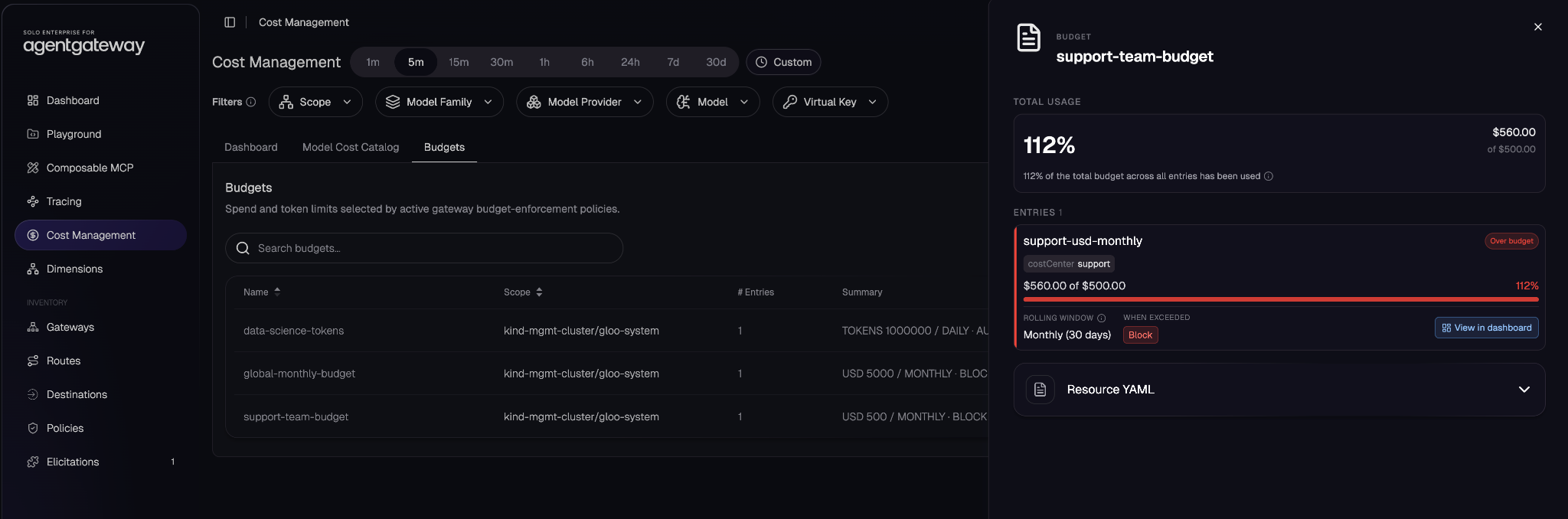
And because budgets are scoped by the very same dimensions as everything else, you can be as broad or as surgical as you like - a ceiling on an entire organization, or a specific limit on one team’s use of one provider. You can even set a catch-all default that applies to everything, and then carve out exact exceptions on top of it, so nothing slips through untracked.
You’re on this rung when: at least one real limit is live and the system enforces it without you. You’re ready to climb when: the guardrails hold and you want to spend less, not just spend bounded.
Rung 4 - Optimize: spend less for the same outcome
The top rung is where governance stops being defense and starts being strategy. Now that you can attribute, observe, and enforce, you have everything you need to systematically drive the bill down without hurting anyone’s work.
The model family view is the sharpest tool here. Grouping spend by family - rather than by every individual model version - reveals the pattern that individual models hide: how much are we spending on the premium tier versus the efficient tier, across every version, everywhere? That’s the question that leads to real savings, because a large share of most AI bills is expensive-model requests that a cheaper model in the same family would have handled just as well.
The catalog makes the trade-off concrete: when you can see that one model costs many times more per token than a capable sibling, “should we default to the cheaper one for this workload” stops being a hunch and becomes a decision with a number attached. And because attribution is in place, you can prove the savings after the fact - the trend line bends, and you can point to exactly which change bent it.
You’re on this rung when: you’re making model and routing decisions based on cost-per-outcome, and you can measure the result.
Where are you right now?
The value of the ladder is that it’s honest. Most organizations discover they’re sitting between rung one and rung two - spending real money, seeing some of it, controlling almost none of it. That’s not a failure; it’s just a starting point, and now it’s a named one.
Pick your rung. Take the next step. Each one pays for itself, and the climb only gets easier from here.



%20(1).png)















%20a%20Bad%20Idea.png)